Rally to stop GHI-HIP merger.
Saturday, May 10, 2008


Saturday, April 5, 2008
About The Healthy, Wealthy & Wise Seminar Series
 My work around financial issues and pensions in particular came shortly about after our last contract as I took a course on pensions at Cornell. This was one of the two best classes of all the courses I have taken at Cornell (the other being Zita Allen’s media class.
Following the pension course I began holding financial workshops in an effort to help members better understand the power of our defined pension plan. Last year, a group of concerned workers in my department (Stations) asked me to join them in setting up some financial seminars.
So I am happy and thankful that after over two years of work that you the members are supporting my efforts. It is quite rewarding and humbling that so many of you from various departments have come out and spent over three hours discussing things that are important to you and your families. Also gratifying are the many positive comments and suggestions (lik
 e the ones below) that let us know this is something that was needed and desired. The topics discussed at the last seminar include credit repair, home buying, 401/457K plans, insurance, workers compensation, our defined pension plan from NYC and of course, the 20/50 bill (A05778).
Future workshops will include another Health Workshop seminar, similar to the last one which focused on diet, exercise, weight loss tips and techniques, strategies and nutrition.
What Members Have to Say:
- "This is a great thing, let's definitely keep this going and expanding."
- "Great - everything I wanted was covered.""Can't get enough information - thanks Marvin!"
- "Very informative. I appreciate the information and hope this continues. We need it."
- "Very good idea to inform members about the 20/50 bill."
- "Great workshop!!"
- "We really needed something like this; thank you so much for doing this."
- "Sign me up for the next one!"
Sunday, March 2, 2008
What Does New Blue Ribbon Panel Mean for our 2009 Contract and the Future of Transit Workers in New York State?
On Thursday, January 17 2007, MTA Chairman Eliot Sander and TWU President Roger Toussaint announced a new blue ribbon panel with the purpose of improving labor relations between the MTA and TWU.
President Toussaint went so far as to say "I think we will resolve the next round of negotiations without a crisis," Toussaint said, calling the day a "milestone.”One has to wonder how Mr. Toussaint came to this conclusion as the stated mission of this panel is to assist MTA leadership in identifying ways to improve efficiency and address the current and future issues that impact the workforce so that the MTA’s mission and vision are achieved.
Nowhere are workers or TWU part of the mission.
The seven person panel, who will have a heavy influence over the lives of transit workers consists of former MTA Chairman Richard Ravitch, and long time labor mediator and arbitrator Hezekiah Brown as co- chairs. The panel also includes state Labor Commissioner Patricia Smith; MTA Chief of Staff Myrna Ramon; MTA board member Susan Metzger, who recently made news with her lack of respect for transit riders; Robert Paaswell, Director of the City College-based University Transportation Research Center, and Sonia Toledo. Also on the panel is Robert B. Catell, Chairman, President and CEO of Key Span Energy Corporation, who is one of Forbes highest paid CEOs (at over 12 million dollars in salary over the past five years.)
Some key items:
1. Workforce Development: There are 16 recommendations in this area of the report - only one of which deals directly with workers - that includes identifying additional training needs, and creating a committee to develop joint programs.
2. Development Succession: There are nine recommendations in this section of the report.
3. Employee Availability: There are 12 recommendations in this section of the report, most of which deal with employees.
4. Labor Management Relations: There are eight recommendations in this section, most of which are already in the contract in one form or the other.
5. Organizational Culture: There are sixteen recommendations in this section, most of which deal with employee recognition. The panel also calls for an MTA-wide culture, as each of the seven MTA agencies has its own unique organizational culture.
More on this topic: Read the report: Workforce Development Report
Opinions & Feedback: Does The Workforce Development Report Work for The Transit Worker?
M.H.
. . . . . . . . . . . . .
President Toussaint went so far as to say "I think we will resolve the next round of negotiations without a crisis," Toussaint said, calling the day a "milestone.”One has to wonder how Mr. Toussaint came to this conclusion as the stated mission of this panel is to assist MTA leadership in identifying ways to improve efficiency and address the current and future issues that impact the workforce so that the MTA’s mission and vision are achieved.
Nowhere are workers or TWU part of the mission.
The seven person panel, who will have a heavy influence over the lives of transit workers consists of former MTA Chairman Richard Ravitch, and long time labor mediator and arbitrator Hezekiah Brown as co- chairs. The panel also includes state Labor Commissioner Patricia Smith; MTA Chief of Staff Myrna Ramon; MTA board member Susan Metzger, who recently made news with her lack of respect for transit riders; Robert Paaswell, Director of the City College-based University Transportation Research Center, and Sonia Toledo. Also on the panel is Robert B. Catell, Chairman, President and CEO of Key Span Energy Corporation, who is one of Forbes highest paid CEOs (at over 12 million dollars in salary over the past five years.)
Some key items:
1. Workforce Development: There are 16 recommendations in this area of the report - only one of which deals directly with workers - that includes identifying additional training needs, and creating a committee to develop joint programs.
2. Development Succession: There are nine recommendations in this section of the report.
3. Employee Availability: There are 12 recommendations in this section of the report, most of which deal with employees.
4. Labor Management Relations: There are eight recommendations in this section, most of which are already in the contract in one form or the other.
5. Organizational Culture: There are sixteen recommendations in this section, most of which deal with employee recognition. The panel also calls for an MTA-wide culture, as each of the seven MTA agencies has its own unique organizational culture.
More on this topic: Read the report: Workforce Development Report
Opinions & Feedback: Does The Workforce Development Report Work for The Transit Worker?
M.H.
. . . . . . . . . . . . .
Monday, February 25, 2008
37th Annual Black and Puerto Rican Legislative Conference
The 37th Annual Black and Puerto Rican legislative conference took place in the state capital on February 15-17 in Albany NY with the theme of the annual caucus weekend being” embracing A United Workforce.”
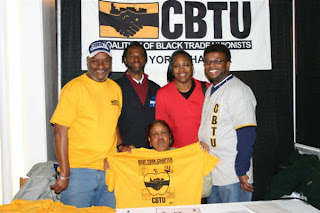 Pictured: Donald Afflick, President NY Chapter CBTU; Marvin Holland, Editor, Homestation Online; Sadie Sanders; Charles Jenkins, NY Chapter CBTU/TWU-Local 100; Sally Robinson (seated).
The annual conference is one the premiere networking and education opportunities for unions and their members. This year the Home Station joined the Coalition of Black Trade Unionists (CBTU) at the conference. There was a buzz of excitement in the air throughout the weekend as the ultra competitive race for the Democratic presidential candidate between Barack Obama and Hillary Clinton was the talk of the weekend. As many of the New York states delegates and super delegates were in attendance (many of them Clinton supporters), the conversations centered around the Obama surge and his emerging front runner status.
The other major political talk was the Democrats opportunity to take control of the Senate for the first time since 1965 (which only lasted 9 months). By gaining just two more seats in the Senate, the Democratic Party can achieve the holy trinity of NY state politics by controlling both the legislative houses and the executive branch in the state of NY. It has been over a century since the Democratic Party has controlled the senate, assembly and governors offices. Chances look good to achieve this milestone, as some long time republican strongholds in upstate have shown strong signs of going democratic in this year’s elections. The Home Station staff met with officers from CBTU NYC Chapter while in Albany to prepare for the 2009 New York City elections.
Charles Jenkins, recently elected 2nd Vice President of their NYC Chapter, and a Vice Chairman in TWU Local 100, was on hand and pointed out that 2009 is huge year for New York City politics as you have the mayor, comptroller, public advocate and four borough presidents. Then you have 36 of 51 term limited city council seats, so 2009 will be major for local politics. Over the next couple of months, we will begin to break down and analyze the races for 2009.
[UPDATE: Since this article was originally posted, the democrats have picked up another seat, and are just one seat shy of taking over the Senate majority.]
Pictured: Donald Afflick, President NY Chapter CBTU; Marvin Holland, Editor, Homestation Online; Sadie Sanders; Charles Jenkins, NY Chapter CBTU/TWU-Local 100; Sally Robinson (seated).The annual conference is one the premiere networking and education opportunities for unions and their members. This year the Home Station joined the Coalition of Black Trade Unionists (CBTU) at the conference. There was a buzz of excitement in the air throughout the weekend as the ultra competitive race for the Democratic presidential candidate between Barack Obama and Hillary Clinton was the talk of the weekend. As many of the New York states delegates and super delegates were in attendance (many of them Clinton supporters), the conversations centered around the Obama surge and his emerging front runner status.
The other major political talk was the Democrats opportunity to take control of the Senate for the first time since 1965 (which only lasted 9 months). By gaining just two more seats in the Senate, the Democratic Party can achieve the holy trinity of NY state politics by controlling both the legislative houses and the executive branch in the state of NY. It has been over a century since the Democratic Party has controlled the senate, assembly and governors offices. Chances look good to achieve this milestone, as some long time republican strongholds in upstate have shown strong signs of going democratic in this year’s elections. The Home Station staff met with officers from CBTU NYC Chapter while in Albany to prepare for the 2009 New York City elections.
Charles Jenkins, recently elected 2nd Vice President of their NYC Chapter, and a Vice Chairman in TWU Local 100, was on hand and pointed out that 2009 is huge year for New York City politics as you have the mayor, comptroller, public advocate and four borough presidents. Then you have 36 of 51 term limited city council seats, so 2009 will be major for local politics. Over the next couple of months, we will begin to break down and analyze the races for 2009.
[UPDATE: Since this article was originally posted, the democrats have picked up another seat, and are just one seat shy of taking over the Senate majority.]
Monday, February 18, 2008
Teachers Pension Bill Passes In Less Than One Month While 20/50 Bill Continues To Sit
In less than one month, the United Federation of Teachers (UFT) was able to get their pension bill A9820 from the governmental employees committee to the Governors desk.
Some will attempt to argue that you can not compare different union contracts and pension improvements and I would argue just the opposite. Comparing two unions in the same city and the same pension fund under the same state laws, who are both seeking pension improvements for their members at the same time is the perfect comparison.
That teachers will go from a 62/30 pension to 55/25 pension is in fact very similar to Transit workers going from a 55/25 pension to a 50/20 pension. Both the teachers and the transit workers will pick up the costs of the pension improvements; teachers will pay an additional 1.85% and transit workers will have to pay an additional 6% . HomeStation will keep of the track the 20/50 bill in what we will call the 20/50 Bill Watch.
One thing is for certain: the rapid movement of the teachers pension bill through the legislative process versus our pension bill going backwards and then virtually dying in committee is a clear indication of which union has more political muscle in New York State. It is time for Local 100 leadership to end its silly internal infighting and begin to build some real political power in this city and state.
M.H.
. . . . . . . . . . . . .
Now I understand that their bill was part of a negotiated contact packaged that included merit pay for teachers. But one can’t help but be impressed with the speed it moved through the various phases.
Their bill arrived at the Governmental Employees Committee on January 23, 2008, and by February 11th it had passed through the Ways and Means Committee where it progressed rapidly, landing on the Governor’s desk for signature on February 15th.
The TWU 20/50 bill arrived at the Governmental Employees Committee a year ago, on February 23, 2007. SIX MONTHS LATER, in June, it was finally reported to the Ways and Means Committee. Rather than progress, however, it sat there for ANOTHER SIX MONTHS, before finally being referred BACK to the Governmental Employees Committee, on January 9th, 2008, where it continues to sit to this date.
So our 20/50 bill moved backwards while theirs moved forwards. (see comparison chart; click on image to enlarge)
So our 20/50 bill moved backwards while theirs moved forwards. (see comparison chart; click on image to enlarge)
Some will attempt to argue that you
 can not compare different union contracts and pension improvements and I would argue just the opposite. Comparing two unions in the same city and the same pension fund under the same state laws, who are both seeking pension improvements for their members at the same time is the perfect comparison.
That teachers will go from a 62/30 pension to 55/25 pension is in fact very similar to Transit workers going from a 55/25 pension to a 50/20 pension. Both the teachers and the transit workers will pick up the costs of the pension improvements; teachers will pay an additional 1.85% and transit workers will have to pay an additional 6% . HomeStation will keep of the track the 20/50 bill in what we will call the 20/50 Bill Watch.
One thing is for certain: the rapid movement of the teachers pension bill through the legislative process versus our pension bill going backwards and then virtually dying in committee is a clear indication of which union has more political muscle in New York State. It is time for Local 100 leadership to end its silly internal infighting and begin to build some real political power in this city and state.
M.H.
. . . . . . . . . . . . .
Tuesday, January 29, 2008
HIP-GHI Conversion Nearly Complete
On Tuesday, January 29th at the HIP headquarters in Lower Manhattan, so many people showed up for a public hearing that by 10:00 am the hearings were temporarily closed to the public. Those who wanted to enter the only public hearing being held in NYC had to wait up to six hours to testify. The majority were against the merger and conversion that would turn GHI and HIP from two separate non-profit entities into one for-profit company, EmblemHealth.
The President of the Medical Society of the State of New York, Dr. Robert Goldberg, who also testified at the hearings believes the conversion of the GHI-HIP insurance company would have a negative impact on patient care and payments to physicians.
This new company will be the largest single health plan in the state, with over four million members and $7 billion in revenue and would dominate the New York metropolitan area. In particular the municipal unions, as over 90% of their members will now be subscribers in this new company. The original merger began in 2005, but was blocked by the mayor until 2006. In November 2006, they were approved by state regulators to operate as affiliates under a governing foundation. While the union is known as EmblemHealth, the companies continue to function under their own names.
At the hearing it became clear that no one knows what the future holds for this new company. In particular, the billions of dollars that will be made when it becomes a private company. One group, New York City union leaders, want their members to become part of any profit sharing model. As Randi Weingarten, President of the UFT put it " .. We want our members, the dedicated city workers who are the real stakeholders who have contributed to the value of HIP/GHI for decades, to get a fair share of the proceeds should the HIP/GHI conversion to a for-profit move forward."
In the past, large company mergers have led to layoffs of long-term workers. To date, at least 160 union workers from HIP have lost their jobs due to this conversion. In addition, non-profits that convert to for-profit health organizations traditionally raise the prices for the cost of care. This is the reason most experts in the medical field believe single payer health care is the better way to go.
A second public hearing is scheduled for Jan. 31 in Albany.
M.H.
. . . . . . . . . . . . .
The President of the Medical Society of the State of New York, Dr. Robert Goldberg, who also testified at the hearings believes the conversion of the GHI-HIP insurance company would have a negative impact on patient care and payments to physicians.
This new company will be the largest single health plan in the state, with over four million members and $7 billion in revenue and would dominate the New York metropolitan area. In particular the municipal unions, as over 90% of their members will now be subscribers in this new company. The original merger began in 2005, but was blocked by the mayor until 2006. In November 2006, they were approved by state regulators to operate as affiliates under a governing foundation. While the union is known as EmblemHealth, the companies continue to function under their own names.
At the hearing it became clear that no one knows what the future holds for this new company. In particular, the billions of dollars that will be made when it becomes a private company. One group, New York City union leaders, want their members to become part of any profit sharing model. As Randi Weingarten, President of the UFT put it " .. We want our members, the dedicated city workers who are the real stakeholders who have contributed to the value of HIP/GHI for decades, to get a fair share of the proceeds should the HIP/GHI conversion to a for-profit move forward."
In the past, large company mergers have led to layoffs of long-term workers. To date, at least 160 union workers from HIP have lost their jobs due to this conversion. In addition, non-profits that convert to for-profit health organizations traditionally raise the prices for the cost of care. This is the reason most experts in the medical field believe single payer health care is the better way to go.
A second public hearing is scheduled for Jan. 31 in Albany.
M.H.
. . . . . . . . . . . . .
Monday, January 21, 2008
Congestion Pricing: Who Speaks For Transit Workers?
By now most of you have probably have heard of Mayor Bloomberg’s plan NYC2030 which has two dozen transportation proposals, but the one that has gotten all the attention is congestion pricing. This means more commuters to a transit system that is already at capacity, and in desperate need of repair.
Both the public and the State legislation rejected the original plan of the Mayor’s which led to the creation of the New York City Traffic Congestion Mitigation Commission, a seventeen-member body directed to undertake a review and study of plans to reduce traffic, congestion and other related and health and safety issues within the city of New York. Our union leadership has supported the Mayor’s congestion pricing plan and continues to do so. Now even the biggest proponents of congestion pricing say that the system is currently unprepared to handle thousands of additional commuters.
The one thing no one -- including our union leadership Local 100 and the Mayor’s research staff -- has studied is the impact it would have on the transit workers. President Toussaint has not only endorsed the Mayor’s plan, he is now pushing the mayor and the MTA’s congestion pricing plan for them. In other words, our union is pushing a plan that would be a new tax on the working class, small business and at the same time increase our workload. He has made this decision not through research from our union but on the homework of the MTA.
Where are the researched reports and the studies conducted by the union? Why has congestion pricing not been on agendas for union meetings? Are we to believe that the Mayor and MTA are doing what’s best for local 100 members? To make matters worse, everyone knows that there are no guarantees that money generated will go only for mass transit. The other key here is how this will be funded, as congestion pricing is very expensive to set up and then to run, especially when you consider that we were all told that this congestion pricing plan would stop mass transit fare increases.
Something is really wrong when union leaders side with the ruling elite to add new taxes that will impact the working class. Make no mistake about, this is a tax on working class New Yorkers no matter what they try to call it. Although congestion is a problem, and the need for more funding for mass transit is critical, both the mayor’s original plan and the alternative plans by the commission are deeply flawed.
There are many groups, coalitions and individuals discussing the plan, both pro and con. The one thing that every one of these debates has in common is no one speaks for the transit worker. It is time that we get in on the debate, and until we know how this will impact every title in transit, I say we keep NYC Congestion Free.
READ MORE:
Transit Unions Split on Congestion Plans, Chief-Leader 1/18/2008
M.H.
. . . . . . . . . . . . .
Both the public and the State legislation rejected the original plan of the Mayor’s which led to the creation of the New York City Traffic Congestion Mitigation Commission, a seventeen-member body directed to undertake a review and study of plans to reduce traffic, congestion and other related and health and safety issues within the city of New York. Our union leadership has supported the Mayor’s congestion pricing plan and continues to do so. Now even the biggest proponents of congestion pricing say that the system is currently unprepared to handle thousands of additional commuters.
The one thing no one -- including our union leadership Local 100 and the Mayor’s research staff -- has studied is the impact it would have on the transit workers. President Toussaint has not only endorsed the Mayor’s plan, he is now pushing the mayor and the MTA’s congestion pricing plan for them. In other words, our union is pushing a plan that would be a new tax on the working class, small business and at the same time increase our workload. He has made this decision not through research from our union but on the homework of the MTA.
Where are the researched reports and the studies conducted by the union? Why has congestion pricing not been on agendas for union meetings? Are we to believe that the Mayor and MTA are doing what’s best for local 100 members? To make matters worse, everyone knows that there are no guarantees that money generated will go only for mass transit. The other key here is how this will be funded, as congestion pricing is very expensive to set up and then to run, especially when you consider that we were all told that this congestion pricing plan would stop mass transit fare increases.
Something is really wrong when union leaders side with the ruling elite to add new taxes that will impact the working class. Make no mistake about, this is a tax on working class New Yorkers no matter what they try to call it. Although congestion is a problem, and the need for more funding for mass transit is critical, both the mayor’s original plan and the alternative plans by the commission are deeply flawed.
There are many groups, coalitions and individuals discussing the plan, both pro and con. The one thing that every one of these debates has in common is no one speaks for the transit worker. It is time that we get in on the debate, and until we know how this will impact every title in transit, I say we keep NYC Congestion Free.
READ MORE:
Transit Unions Split on Congestion Plans, Chief-Leader 1/18/2008
M.H.
. . . . . . . . . . . . .
Friday, January 18, 2008
UPDATE ON 20/50 BILL (A5778)
January 14, 2008 A new bill was been introduced last year by Assemblyman Peter J. Abbate, Jr., which would allow employees of the New York City Transit Authority, who are members of NYCERS, to retire with a full pension after 20 years of service at the age of 50.
This new bill (A5778) was in the Ways and Means Committee when session closed in June 2007 in Albany at the state capital. This means it did not have a chance of reaching the Governor’s desk until sometime in 2008. Governor Pataki vetoed a similar bill back in 2004,but this new bill is cost neutral to the state, as it calls for an additional (6 percent) contribution from members who wish to opt into the 20/50 plan. The bill that was vetoed in 2004 called for a 5.5 percent increase. It was vetoed by Pataki for not being cost neutral.
Currently members can retire at age 55 after 25 years of service. If and when the 20/50 bill becomes the law current members will have option of remaining in 25/55, or may elect to enter into the new 20/50 plan. But all new members hired will be required to enter into the 20/50 plan, except those who are over 41 years of age at the time of hire, who may elected the 25/55 plan. As you can see, 20/50 is not being given to transit workers but will cost us an additional 6% of our salary. To put this in perspective, multiply whatever you are paying for the 1.5% (see healthplancont on your check or stub) by 4 and that will give you an idea of what 20/50 will cost you personally.
I am pointing this out to my fellow transit workers so we can begin to understand more about our pension plan and that we must pay for 20/50; it is not being given to us. And also to provide an awareness that we will need to prepare our finances if 20/50 is ever passed into law so we can actually take advantage of 20/50. We need to have detailed information at meetings about the 20/50 plan so all members understand exactly what is in the bill, and how it will impact them.
This lack of information along with dearth of questions is why I am putting this out to the membership, and why I made the 20/50 bill discussion a part of the Homestation Healthy, Wealthy and Wise Seminar Series™. There needs to be more education on pensions and the pension process under the Taylor Law. If 20/50 is important to you, remember it’s the state legislators and the governor who control the fate of 20/50. This means we must get politically active to move the 20/50 bill.
Have you written a letter to your assembly or state senator? How about visiting them in their offices where you live? This type of ongoing political action is what is needed to move our bills and to complement our annual lobby day. Next week, we will be covering exactly how you can contact your state legislators and the governor, along with sample letters and petitions to send to the capital.
What You Can Do Now:
Tell Us What You Think: Visit the Message Boards and join in the conversation on The 20/50 Bill.
M.H.
. . . . . . . . . . . . .
This new bill (A5778) was in the Ways and Means Committee when session closed in June 2007 in Albany at the state capital. This means it did not have a chance of reaching the Governor’s desk until sometime in 2008. Governor Pataki vetoed a similar bill back in 2004,but this new bill is cost neutral to the state, as it calls for an additional (6 percent) contribution from members who wish to opt into the 20/50 plan. The bill that was vetoed in 2004 called for a 5.5 percent increase. It was vetoed by Pataki for not being cost neutral.
Currently members can retire at age 55 after 25 years of service. If and when the 20/50 bill becomes the law current members will have option of remaining in 25/55, or may elect to enter into the new 20/50 plan. But all new members hired will be required to enter into the 20/50 plan, except those who are over 41 years of age at the time of hire, who may elected the 25/55 plan. As you can see, 20/50 is not being given to transit workers but will cost us an additional 6% of our salary. To put this in perspective, multiply whatever you are paying for the 1.5% (see healthplancont on your check or stub) by 4 and that will give you an idea of what 20/50 will cost you personally.
I am pointing this out to my fellow transit workers so we can begin to understand more about our pension plan and that we must pay for 20/50; it is not being given to us. And also to provide an awareness that we will need to prepare our finances if 20/50 is ever passed into law so we can actually take advantage of 20/50. We need to have detailed information at meetings about the 20/50 plan so all members understand exactly what is in the bill, and how it will impact them.
This lack of information along with dearth of questions is why I am putting this out to the membership, and why I made the 20/50 bill discussion a part of the Homestation Healthy, Wealthy and Wise Seminar Series™. There needs to be more education on pensions and the pension process under the Taylor Law. If 20/50 is important to you, remember it’s the state legislators and the governor who control the fate of 20/50. This means we must get politically active to move the 20/50 bill.
Have you written a letter to your assembly or state senator? How about visiting them in their offices where you live? This type of ongoing political action is what is needed to move our bills and to complement our annual lobby day. Next week, we will be covering exactly how you can contact your state legislators and the governor, along with sample letters and petitions to send to the capital.
What You Can Do Now:
Tell Us What You Think: Visit the Message Boards and join in the conversation on The 20/50 Bill.
M.H.
. . . . . . . . . . . . .
Monday, January 14, 2008
AFL-CIO Executive Vice President Speaks at Cornell ILR School
 On January 11, Arlene Holt Baker, the new Executive Vice President of the AFL-CIO, gave an informative and inspiring speech at the Cornell ILR School in Manhattan.
Ms. Holt Baker, who has been a union and community organizer for over thirty years, was approved by the AFL-CIO Executive Council on September 21, 2007 to be Executive Vice President, becoming not only the highest-ranking woman in the union movement but also becomes the first African American to be appointed to one of the three highest offices in the AFL-CIO.
Ms. Holt Baker began her union work with AFSCME and worked her way through the union ranks from organizer to international union director. In 1995, Holt Baker went to the AFL-CIO as executive assistant to the Executive Vice President Linda Chavez-Thompson. As the first director of the AFL-CIO Voice at Work campaign in 1999, she launched an active movement to bring together community leaders, clergy members, farm workers and elected official and others in support of the workers’ right to form unions. After leaving the AFL-CIO for a couple of years to serve as President of the Voices of Working Families (a nonpartisan organization effort which registered thousands of women and people of color to vote), Ms. Holt Baker returned to the AFL-CIO in 2006 to lead the Gulf Coast Recovery effort.
In her speech Ms. Holt Baker was informative on the issues of immigration, healthcare, African American unemployment rates and the need to organize for the upcoming presidential election this year. Ms. Holt Baker pointed out the enormous challenges facing all working class people at this point in history. Ms. Holt Baker also talked about the plans for the AFL-CIO’s political and membership mobilization program, Labor 2008,which will be the largest political mobilization ever undertaken by the union movement with some 53 million dollars budgeted alone by the AFL-CIO for this election.
Her presentation was inspiring as she quoted Dr. King’s speech from the 1961 AFL-CIO convention, and reminded us all how the struggle for civil rights and workers’ rights were one and the same. She also noted that the only time that there has been change and progress in the United States is when people of diverse backgrounds have worked together. With Dr. King’s birthday approaching, it’s time we all recommit ourselves to the struggle for progress and change through the political process, community activism, union activism or whatever form of action you can take.
M.H.
. . . . . . . . . . . . .
Monday, December 10, 2007
Standing Room Only at December 6th Healthy, Wealthy & Wise (tm) Financial Seminar

It was standing room only as HomeStation and the Concerned Workers’ Group closed out its Lifestyle Seminars Series with its last financial workshop for 2007. Members from Stations, RTO, CED, MOW and TA bus joined in unity and solidarity to be educated on topics ranging from credit repair and home buying to banking options and pensions.
We expect our already impressive line up of guest speakers to continue to grow in 2008 as representatives from various companies such as CitiBank and New York Life contact us and ask if they can give presentations at upcoming financial seminars in 2008. These companies will look join our representatives from Merrill Lynch, Chase Bank and First Republic Bank.
We expect our already impressive line up of guest speakers to continue to grow in 2008 as representatives from various companies such as CitiBank and New York Life contact us and ask if they can give presentations at upcoming financial seminars in 2008. These companies will look join our representatives from Merrill Lynch, Chase Bank and First Republic Bank.

We’re pleased that Norman Rosenfeld, retired Deputy Director of NYCERS, has agree to join us in up coming seminars in 2008 to answer all your NYCERS pension-related questions. We’re also pleased to welcome retired track worker Joel Fredericson on board. Mr. Fredericson was one of the architects of the TWU local 100 Workers compensation department, and he can answer all your workers comp questions. We expect Mr. Fredericson and Mr. Norman Rosenfeld to be regular contributors to the HomeStationOnline portal as well.
These seminars started out with a small group of concerned transit workers from Stations Department, and has grown to include members from a variety of departments and divisions. This is only the beginning; in early 2008 we will begin the Health series and in spring 2008 we will begin a new politics and labor series. Some of the most renowned guest lectures in their respective fields of health, politics and labor education have already given the Home Station commitments to speak at our workshops. All our guest speakers bring packages and materials for the members to take home and study, and there is always an ample question and answer period for your specific concerns.
Remember there is never a charge or fee at our seminars and workshops, nor are you obligated to buy anything or utilize the services. These events are solely for the information and education of members, so that transit workers in the can make the best decisions for themselves, both in the union and in the communities where we live. That’s why we hold these seminars all over the city: we want to take unionism back to the communities we live in while at the same time bring all Local 100 members together on an ongoing basis to build unity and solidarity inside Local 100.
So be on the lookout for details in the upcoming weeks on the next series, come out and find out what your co-workers are talking about, and begin to take the next steps to becoming healthier, wealthier and wiser.
These seminars started out with a small group of concerned transit workers from Stations Department, and has grown to include members from a variety of departments and divisions. This is only the beginning; in early 2008 we will begin the Health series and in spring 2008 we will begin a new politics and labor series. Some of the most renowned guest lectures in their respective fields of health, politics and labor education have already given the Home Station commitments to speak at our workshops. All our guest speakers bring packages and materials for the members to take home and study, and there is always an ample question and answer period for your specific concerns.
Remember there is never a charge or fee at our seminars and workshops, nor are you obligated to buy anything or utilize the services. These events are solely for the information and education of members, so that transit workers in the can make the best decisions for themselves, both in the union and in the communities where we live. That’s why we hold these seminars all over the city: we want to take unionism back to the communities we live in while at the same time bring all Local 100 members together on an ongoing basis to build unity and solidarity inside Local 100.
So be on the lookout for details in the upcoming weeks on the next series, come out and find out what your co-workers are talking about, and begin to take the next steps to becoming healthier, wealthier and wiser.
Wednesday, December 5, 2007
1500 Members in Attendance for Mass Membership Meeting

On Saturday December 1st, TWU Local 100 held its annual mass membership meeting. Approximately 1500 members showed up for the 4:00 pm meeting located at the Jacob Javits Center in midtown Manhattan. Local 100 Secretary Treasurer Ed Watt was the MC of the meeting and the evening. Speakers for the evening were Bill Thompson, comptroller of NYC; James Little, President, TWU International, and Roger Toussaint, President, TWU-Local 100.
The first speaker was Bill Thompson, the comptroller of NYC, who is running for Mayor of New York City in 2009.
Bill Thompson also serves as Chief Investment Advisor and Custodian of Assets to all of the New York City Pension Funds, and as a Trustee of four of the Pension Funds. The City’s Pension Funds currently have more than $110 billion in assets. He assured TWU Local 100 members that there NYCERS pensions were doing quite well and were secure. Mr. Thompson also stated that the NYC Transit system would not be in a state of good repair until 2022. He talked about meeting with TWU Local 100 leadership about using pension funds to build affordable housing for transit workers as other unions do.
The next speaker, International TWU President James Little gave an overview of TWU. His presentation centered on the organizational changes he made by adding seven new people and more diversity in the civil rights department, and increasing the TWU organizing department from 4 to 14 as well as changes he has made in staff at the international to make it more efficient. Other topics addressed included successful organizing drives in the casinos in Las Vegas and how TWU had sit out to do more organizing in the casinos. Mr. Little also talked about why the TWU endorsed John Edwards and that this was done after discussion amongst TWU leaders and activists, and was not done in a vacuum.
The final speaker of the night was TWU-Local 100 President Roger Toussaint. He started off by stating there was a new, improved relationship between local 100 and the International, and stated a strong and united union must be our goal. He then went on to talk about the MTA Bus contract -- or lack thereof.
For those of you not familiar with MTA Bus, these are the former private line bus members who went out on strike 24 hours before the rest of us. These brothers and sisters in MTA Bus do the same work as our OA and TA Bus members but for less pay. President Toussaint stated that solving the MTA Bus Contract is the # 1 Priority of TWU Local 100.
President Toussaint said the Jan 2009 contract would not be a rerun of the 2002 or the 2005 contract and that every contract is different. He did not talk beyond that on what the 2009 contract priority would be except to say only members and officers in good standing would be allowed to give input on our contract priorities
The President then talked about the new political landscape in NY state and that the 2008 national election would be a dress rehearsal for the NY city elections in 2009. With this in mind, the union has started a very aggressive COPE campaign to collect more funds for their political action plans.
With regards to the 20/50 pension issue, President Toussaint only said that”20/50 may not be attainable in this round of bills.” He stated that we may get only one shot under Governor Spitzer and should we take that shot in 2008, as 2009 or 2010 remains to be seen. He also point out pension improvements would be against the national trend. So the union is looking to come up with the data to support our case that transit workers deserve a 20/50 pension.
The next item on the agenda was the dues check off situation. The consensus was that the union could be without dues check off for quite a bit longer. Whereas the MTA was willing to let Local 100 regain check-offs, the Mayor took a hard line and blocked its return. Therefore, the union has entered what was called PHASE II of collecting union dues and make it a more permanent structure. The meeting closed out at approximately 6:30 p.m.
The first speaker was Bill Thompson, the comptroller of NYC, who is running for Mayor of New York City in 2009.
Bill Thompson also serves as Chief Investment Advisor and Custodian of Assets to all of the New York City Pension Funds, and as a Trustee of four of the Pension Funds. The City’s Pension Funds currently have more than $110 billion in assets. He assured TWU Local 100 members that there NYCERS pensions were doing quite well and were secure. Mr. Thompson also stated that the NYC Transit system would not be in a state of good repair until 2022. He talked about meeting with TWU Local 100 leadership about using pension funds to build affordable housing for transit workers as other unions do.
The next speaker, International TWU President James Little gave an overview of TWU. His presentation centered on the organizational changes he made by adding seven new people and more diversity in the civil rights department, and increasing the TWU organizing department from 4 to 14 as well as changes he has made in staff at the international to make it more efficient. Other topics addressed included successful organizing drives in the casinos in Las Vegas and how TWU had sit out to do more organizing in the casinos. Mr. Little also talked about why the TWU endorsed John Edwards and that this was done after discussion amongst TWU leaders and activists, and was not done in a vacuum.
The final speaker of the night was TWU-Local 100 President Roger Toussaint. He started off by stating there was a new, improved relationship between local 100 and the International, and stated a strong and united union must be our goal. He then went on to talk about the MTA Bus contract -- or lack thereof.
For those of you not familiar with MTA Bus, these are the former private line bus members who went out on strike 24 hours before the rest of us. These brothers and sisters in MTA Bus do the same work as our OA and TA Bus members but for less pay. President Toussaint stated that solving the MTA Bus Contract is the # 1 Priority of TWU Local 100.
President Toussaint said the Jan 2009 contract would not be a rerun of the 2002 or the 2005 contract and that every contract is different. He did not talk beyond that on what the 2009 contract priority would be except to say only members and officers in good standing would be allowed to give input on our contract priorities
The President then talked about the new political landscape in NY state and that the 2008 national election would be a dress rehearsal for the NY city elections in 2009. With this in mind, the union has started a very aggressive COPE campaign to collect more funds for their political action plans.
With regards to the 20/50 pension issue, President Toussaint only said that”20/50 may not be attainable in this round of bills.” He stated that we may get only one shot under Governor Spitzer and should we take that shot in 2008, as 2009 or 2010 remains to be seen. He also point out pension improvements would be against the national trend. So the union is looking to come up with the data to support our case that transit workers deserve a 20/50 pension.
The next item on the agenda was the dues check off situation. The consensus was that the union could be without dues check off for quite a bit longer. Whereas the MTA was willing to let Local 100 regain check-offs, the Mayor took a hard line and blocked its return. Therefore, the union has entered what was called PHASE II of collecting union dues and make it a more permanent structure. The meeting closed out at approximately 6:30 p.m.
Subscribe to:
Posts (Atom)
